Backgammon Board Setup Explained
BlogSetting Up the Board
Setting up a backgammon board takes less than a minute once you know the pattern. Every game begins with the same arrangement, and getting it right matters: even one checker on the wrong point throws off the opening. The good news is that the pattern's easy to remember, and after a few games it will feel automatic. This guide walks through the board, the checkers, the equipment, and the variations you might encounter.
Understanding the Backgammon Board Layout
The board has 24 narrow triangles called points, numbered 1 to 24. A raised divider down the middle, known as the bar, splits the board into two halves:
- Your home board: points 1–6 (the quadrant closest to you, where you bear off).
- Your outer board: points 7–12.
- Opponent's outer board: points 13–18.
- Opponent's home board: points 19–24.
The numbering works in opposite directions for each player. Your 1-point is your opponent's 24-point, and vice versa. Colours on the triangles alternate for visibility but have no gameplay function.

Step-by-Step Checker Placement
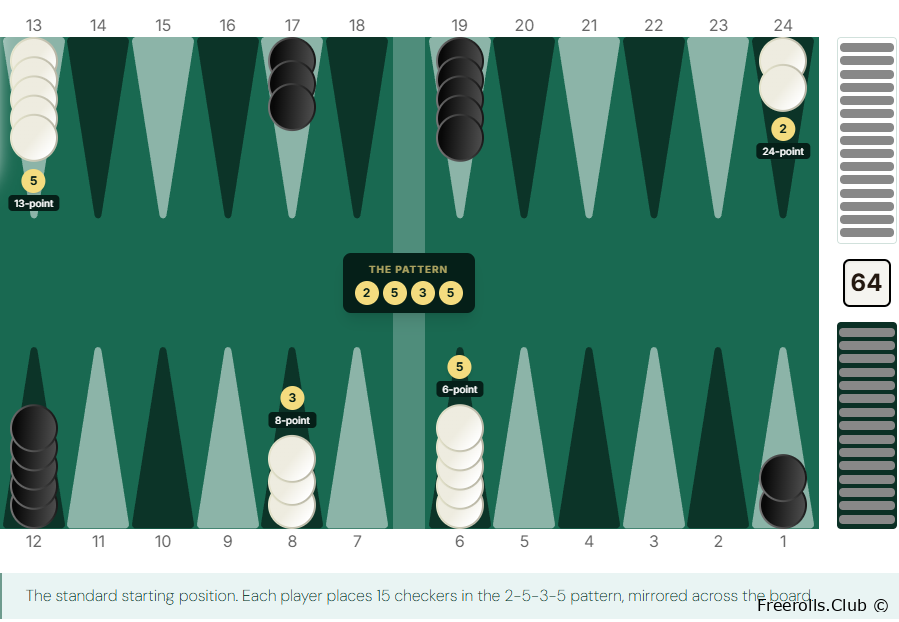
Each player sets up 15 checkers in the same fixed pattern. Think of it as the 2-5-3-5 rule:
- 2 checkers on the 24-point (your farthest point, deep in the opponent's home board).
- 5 checkers on the 13-point (the midpoint, at the start of your opponent's outer board).
- 3 checkers on the 8-point (in your outer board).
- 5 checkers on the 6-point (in your home board).
Your opponent places their 15 checkers in the exact mirror image: their 2 go on the 1-point (from their perspective, the 24-point), their 5 on the 12-point, their 3 on the 17-point, and their 5 on the 19-point.
Direction of Play and Movement Flow
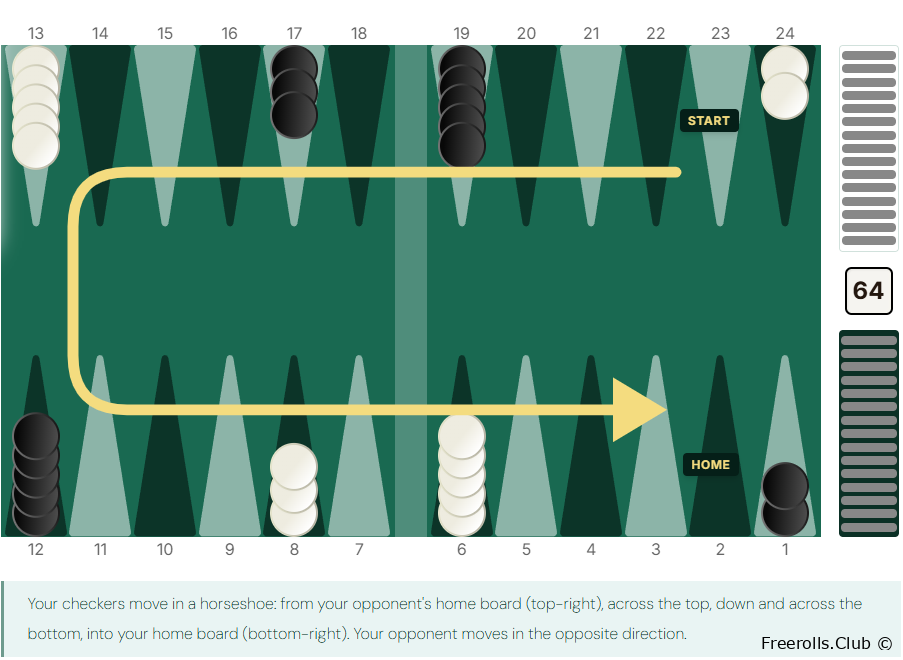
Checkers move in a horseshoe path. You move from your opponent's home board (high-numbered points) through the outer boards and into your own home board (low-numbered points). Your opponent moves the opposite direction. The two players are always heading toward opposite ends of the board.
Equipment and Accessory Setup
Beyond the board and checkers, a standard setup includes:
Doubling cube: a six-faced marker showing the numbers 2, 4, 8, 16, 32, and 64. It starts centred on the bar with the 64 face up (representing a starting value of 1).
Two pairs of dice: one pair for each player.
Dice cups: one per player. In serious play, cups with a lip (a small ridge inside) help ensure a fair roll by preventing controlled throws.
Some sets include a scoreboard or score sheet, but those aren't required for play.
Common Setup Variations
The standard setup described above is used in most backgammon worldwide, but two popular variants change the starting arrangement:
Nackgammon
Created by Nack Ballard. Moves one checker each from the 13-point and the 6-point to the 24-point, giving each player four back checkers instead of two. This creates more contact and longer games.
Acey-Deucey
A military variant where all checkers start off the board and are entered during play. The board begins empty.
on website to post or comment You can register HERE