Backgammon Pip Counting
BlogBackgammon Pip Counting
A note on online play: the pip count is displayed automatically on screen during online games. You don't need to calculate it manually when playing online. This article is essential for live tournament play and for understanding why the pip count matters in every game, online or over the board.
The pip count is the single most important number in backgammon. It tells you who is winning the race, it drives your doubling decisions, and it tells you whether your strategy should be running for home or staying back to fight. This is the one skill that will make the biggest difference in your game. And it's easier to pick up than you might think.
What is Backgammon Pip Counting?
Your pip count is the total distance (measured in points) that all of your checkers must travel to bear off. Each checker's contribution is equal to the point number it sits on. Three checkers on the 6-point contribute 18 pips. Two on the 4-point contribute 8. Add up all 15 checkers and you have your total pip count.
The player with the lower count is ahead in the race. The player with the higher count is behind. Once you know these numbers, you stop guessing and start making decisions based on real information.
Why the Pip Count Matters in Strategy
The pip count is relevant in three main ways:
Racing decisions: once contact between the two sides is broken, the player with the lower pip count leads the race. The size of the lead determines whether to double. Pip count and doubling cube decisions are directly linked: you can't make a correct cube action in a race without knowing the count.
Cube decisions: a pip count lead of 8 to 12% of the total race is the standard window for offering a double in a pure race. This is where the numbers meet the real-world pressure of the cube.
Strategic direction: if you're far behind in the pip count, running home is a losing strategy. Instead, hold an anchor, look for hitting chances, and try to change the game. If you're well ahead, break contact and race. Just knowing who is ahead gives you a clear direction.
How to Count Pips: Popular Techniques
Direct Counting
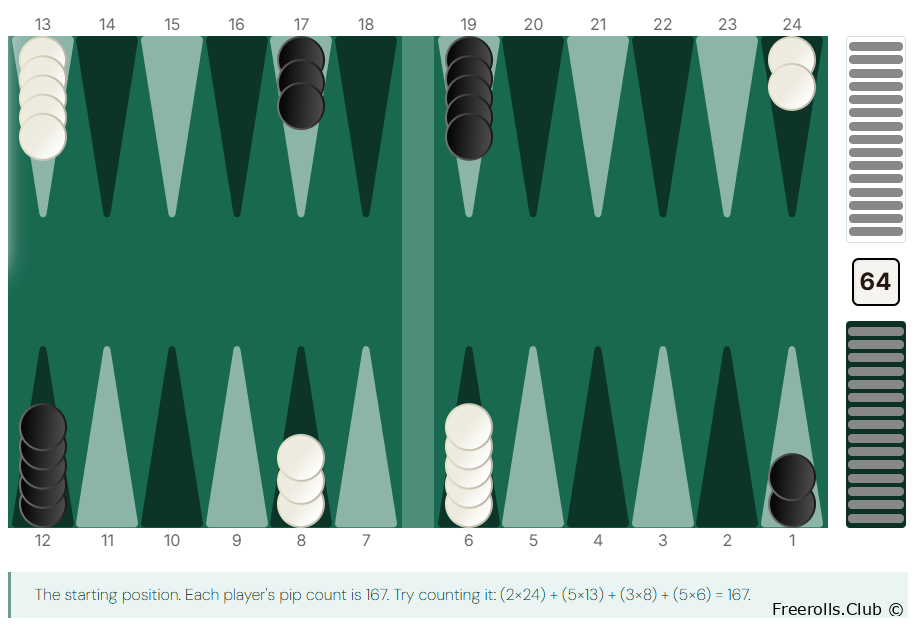
The straightforward approach: add up every checker one by one. It's slow, but it's accurate, and it's how everyone starts. A useful shortcut is to memorize the starting pip count (167 for each player at the beginning of every game) and then track changes as moves happen rather than recounting from scratch. This tracking method gets faster with practice and is the foundation for all the other techniques.
You don't need to count pips to play backgammon - plenty of people never do. But once you start, you'll spot winning positions and doubling opportunities that other players miss. Don't worry if it feels awkward at first. It gets easier with practice, and there are shortcuts to help.
Cluster Counting
Group checkers visually rather than counting them individually. Five checkers on the 6-point is 30 pips. Two on the 13-point is 26. Adding clusters is faster than adding individual checkers, and most players find this method strikes the best balance between speed and accuracy.
The key to cluster counting: mentally shift checkers to nearby reference points you can multiply quickly. Move two checkers from the 13-point to the 14-point and one from the 15-point to the 14-point, and you have three checkers on the 14-point (42 pips) instead of adding 13 + 13 + 15 separately. The total is the same, but the arithmetic is simpler.
This is widely considered the fastest backgammon pip counting method for over-the-board play.
Relative Counting
Instead of counting both sides separately, count only the difference. Cancel out matching checkers and count what remains. This is efficient when you just need to know who is ahead and by how much, without needing the exact totals. Relative counting works best when the positions are similar and you want a quick read on the race margin.
Using the Pip Count: Basic Formulas
The 8-9-12 Rule
For pure race positions: an 8% lead in pip count means you're approaching doubling range. A 9% lead is a correct double. A 12% lead puts the opponent at a borderline take. These percentages refer to your lead as a fraction of the total race length (both counts combined).
Example: if the total combined pip count is 160 and you lead by 15 pips, your lead is about 9.4%. That puts you squarely in doubling territory.
The Rule of 62
Here's a handy shortcut: in a medium-length race, if your pip count is 62% or less of the combined total, you have a healthy lead. It's a rough check, not a precise tool. But it's quick to work out at the table and useful for confirming your read before making a cube decision. Think of it as a gut-check formula.
Beyond the Raw Number: Effective Pip Count (EPC)
The raw pip count can be a bit misleading. The effective pip count adjusts for wastage - pips that get thrown away during bearing off because you roll higher numbers than you need.
Here's an example to make it concrete. Five checkers stacked on the 6-point have a raw count of 30 pips, but they waste a lot during bearing off because high rolls overshoot repeatedly. Five checkers spread across points 1 through 5 have a raw count of only 15 pips, and they waste much less. The stacked position has a higher effective pip count. Good checker distribution means lower wastage and a truer pip count.
This gap between raw count and effective count is biggest when checkers are bunched on high points or when very few checkers remain. In close races, getting this right is the difference between a correct double and a blunder.
Tools and Practice Drills
When playing online, the pip count is displayed automatically during games, which is helpful for study and for verifying your mental count. In live play and tournaments, you count manually. Speed comes with practice.
- Start by verifying the 167 starting count at the beginning of each game. This gives you a reliable anchor point.
- Track changes as moves happen rather than recounting the entire board. Each die you play moves a checker that many pips forward. Keep a running total.
- Try counting random positions for 30 seconds each until it becomes second nature. Set up positions online and try to get the count before looking at the displayed number.
- Compare raw count to effective count in bearing-off positions to train your feel for wastage.
on website to post or comment You can register HERE